 Croatia Waterfalls
The Miljacka slap is the middle Krka at its most concentrated: a strong single drop of 23.8 metres and 50-60 metres of width, where the river gathers itself between tall cliffs three steps down toward Visovac lake — all of it watched over by the Miljacka hydroelectric plant on the left bank, once the most powerful in Europe. The barrier sits in the roadless heart of the canyon between Kistanje and the park's visited half, free at the roadside end of quiet backroads, and it is one of the barriers the excursion boats pass at closest range without ever landing. This page covers the fall, the power-station history and the backroad access logic.
Quick answer The drop, the hydro plant, the free access and the backroads in one read
Verified this quarter: the barrier drops 23.8 m over three large travertine steps, 50-60 m wide, 21.5 km from the river's source — the fifth waterfall on the Krka. It is free at the roadside end of the backroads between Kistanje and Roški slap, with no desk and no tours. The Miljacka hydro plant below it is the largest on the river and was Europe's most powerful until 1910. The park's own locality page and the Krka falls guide carry the wider context; the free-falls list sits on the free waterfalls page.
Key takeaways
- Free, always open, no desk: a backroad stop in the roadless middle canyon.
- 23.8 m drop, 50-60 m wide, three large travertine steps — a concentrated single fall.
- The Miljacka plant below it is the largest on the Krka; Europe's most powerful until 1910.
- No tours stop here; access is the quiet road network between Kistanje and the park.
- The excursion boats pass at close range — the river-level view is theirs, the bank view is free.
Key facts
Opening hours
| Roadside site, always visible | 00:00–24:00 |
|---|
Closed None — an open roadside barrier with no gates or ticket desk
Admission
- Adult
- Free — the barrier sits outside the paid localities; access via the quiet backroads between Kistanje and the park
- Reduced
- Free
- Free
- Everyone
Planning it
- Time needed
- 20-30 min
- Address
- Middle Krka canyon by the Miljacka hydro plant, between Kistanje and Roški slap, Croatia
Miljacka Slap: Free Access and the Nearest Bookable Products
No ticket is sold at the barrier; the official rows point to the park's own sources and the tour rows mark the nearest bookable products for a no-car traveler.
The barrier costs nothing; the products below buy the park downstream instead:
| Option | Season / window | Adult price | What it covers | Where it books | Book |
|---|---|---|---|---|---|
| The barrier itself — official locality pageAnyone planning the backroad stop | Open all year | Free | The canyon fall and the power-station setting | Official locality page | Official site |
| Krka park price list (2026 PDF)Anyone extending the day into the paid park | Season bands per locality group | Roughly €10-40 peak — confirm on the list | The paid land localities downstream | Official cjenik | Official site |
| Afternoon tour from Zadar, tickets includedZadar-based visitors without a car | Afternoon departures in season | From ~$75 on the card | The nearest Krka product — it visits the main barrier, not this canyon stop | Tour card | Check Availability |
| Guided park tour from SplitSplit-based visitors on a region loop | Daily in season | From ~$75 on the card | The nearest bookable regional product — again the paid park | Tour card | Check Availability |
| Reaching the base of the fallAnyone chasing a river-level view | All year | Not provided | The barrier is viewed from the bank above; the canyon bottom belongs to the river and the plant | Skip it — take the bank view | Check Availability |
A Strong Drop in a Roadless Canyon
The park's numbers: 23.8 metres of height, 50-60 metres of width, three large travertine steps, fifth waterfall on the river.
Miljacka slap sits 21.5 kilometres from the Krka's source, the fifth barrier on the river's course to the sea, and it is the canyon's concentrated punch: 23.8 metres of drop packed into a fall 50-60 metres wide, built from three large travertine steps plus a scatter of smaller ones. The upper cascade runs between tall cliffs bearded with travertine and half-caves; the lower steps spread onto low ledges where the river regathers. It is a fall you hear before you see — the canyon holds the sound — and one you usually see from the bank above rather than the water below, because the middle Krka is roadless country crossed only by the excursion boats.
The engineering is half the story. On the left bank below the fall sits HE Miljacka, the largest hydroelectric plant on the Krka, whose predecessor was described as the most powerful in Europe until 1910. The plant explains two things a visitor notices: the access road exists at all (the canyon is otherwise trackless), and the river's flow is regulated — the barrier runs strong on plant schedule, which is why the excursion boats' canyon cruise shows it at its best. The hydrogeology beneath is stranger still: the Miljacka spring, which rises in the canyon here, is the documented underground connection between the Krka and the Zrmanja catchments on the other side of the plateau — two rivers sharing water through the karst. Nearby opens Špilja Miljacka II, the largest cave in the park, home to olms and long-legged bats.
- 23.8 m drop, 50-60 m wide, three large steps — the fifth barrier, 21.5 km from the source.
- HE Miljacka below the fall: the largest plant on the Krka; Europe's most powerful until 1910.
- The Miljacka spring documents a rare underground link between the Krka and Zrmanja catchments.
- Špilja Miljacka II, the park's largest cave, opens nearby — protected, not visitable.
Dimensions, the power-plant history and the hydrogeology from the park's Miljacka slap locality page, verified this quarter.
The Backroads Between Kistanje and the Park
Access is the reason most visitors never see this fall, and the reason the ones who do have it to themselves.
The barrier sits on the quiet road network that links Kistanje — the gateway town on the river's middle course, serving the Krka monastery entrance — with the Roški slap side of the park. From Kistanje the drive is roughly 20-30 minutes; from the Roški slap circuit or the Burnum fork, 20-40 minutes depending on the fork taken. The road is tarmac but narrow, unsigned at the last turns, and the parking is informal at the roadside above the canyon. There is no desk, no railing budget and no facilities; the viewpoint is the bank where the road meets the canyon, and the fall announces itself by sound before the trees open.
Planning honesty: this is a driver's stop, full stop. No public transport crosses the middle canyon, no tour in the bookable list comes near it, and the nearest bookable products — the Zadar afternoon tour and the Split park tours — cover the paid park. The stop earns its place as one link in the upper-river circuit: Kistanje monastery, this fall, the Manojlovac terrace and the Roški slap mills make a coherent half-day by car, and the road-trip circuit chains the whole set. Kayakers get the river-level equivalent on the Zrmanja kayak run — a different canyon, same karst logic.
- From Kistanje: 20-30 minutes on narrow tarmac; unsigned at the last turns.
- Informal roadside parking above the canyon; the fall is heard before it is seen.
- No facilities and no phone signal guarantee — self-sufficient stop.
- Pair with the Krka monastery at Kistanje and the Manojlovac terrace for a half-day loop.
- Fuel up in Kistanje or Knin — nothing sells on the canyon roads.
- Real shoes: the bank paths are grass and rock.
- Park rules apply at the free sites: no bathing, no drones, stay on the paths.
Access framing from the park's locality and entrance pages, verified this quarter; drive times are practical estimates on the local road network.
The Middle-Canyon Barriers Compared
The three stops of the middle and upper canyon, compared from the park's locality pages verified this quarter.
| Barrier | Drop | Access point | Flow character | Best paired with |
|---|---|---|---|---|
| Miljacka slap | 23.8 m, three large steps | Backroads by the power plant | Strong, hydro-regulated | Kistanje monastery and the Manojlovac terrace |
| Manojlovac slap | Roughly 60 m over steps | Free terrace above the canyon | Tallest on the river; thins in warm months | Roški slap and the Burnum fork |
| Roški slap | 25.5 m over 650 m | Ticketed locality via Laškovica | Low necklace curtains, mills | Skradinski buk and the boat loop |
Miljacka Slap Map: the Fall, the Plant and the Backroads
The barrier in its canyon, the Kistanje gateway north of it and the pairing stops of the backroad day.
The Nearest Bookable Tours
No tours stop at this barrier — the middle canyon has no coach road and no ticket desk. The nearest bookable Krka products are below; they cover the paid park and leave the backroads to your own car.
 from $75.16
From Zadar: Krka Waterfalls AFTERNOON Tour -TICKETS INCLUDED
Afternoon Krka trip from Zadar with tickets included — built for the quiet late hours.
Check Availability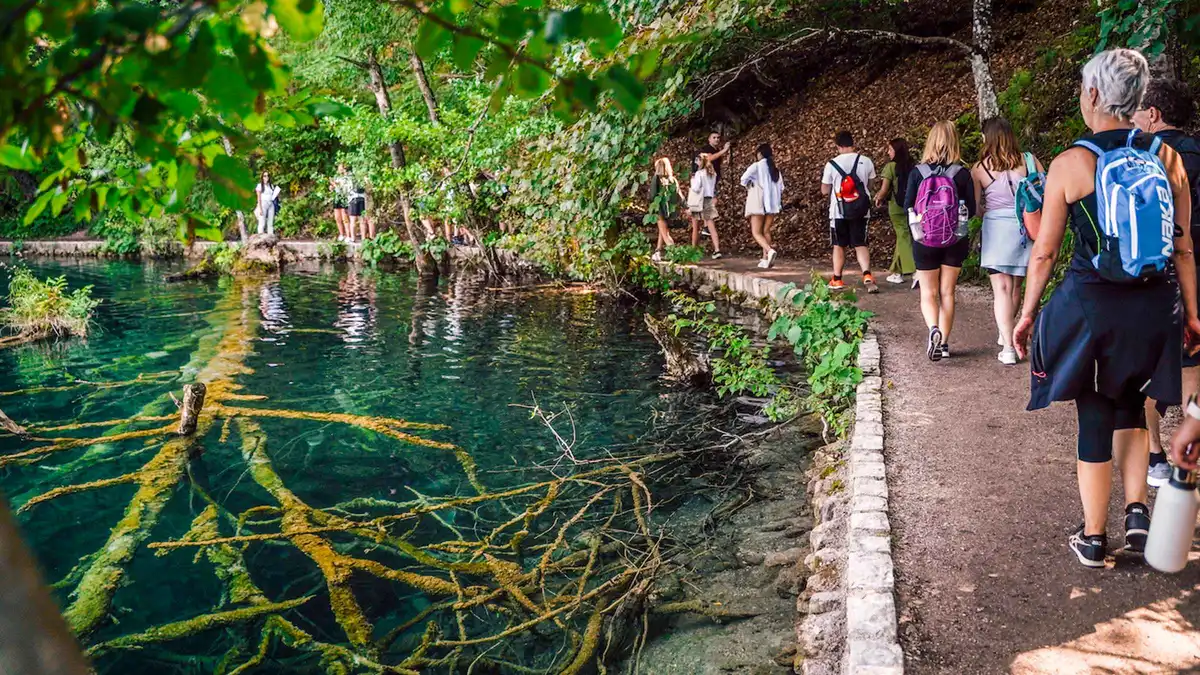 from $75.39
From Split: Plitvice Lakes National Park Guided Tour
Guided Plitvice day tour from Split covering the UNESCO lake terraces with hotel-zone pickup.
Check AvailabilityPrices, ratings and details are the platform's own, checked in Q3 2026; dollar figures are the listed prices — the platform bills in your account's currency.
Is Miljacka slap free to visit?
Yes. The barrier sits outside the paid localities — no ticket, no desk, informal roadside parking. The free-falls list for the whole country sits on the free waterfalls page.
How big is the fall?
The park lists 23.8 metres of height and 50-60 metres of width, built from three large travertine steps plus smaller ones — the fifth barrier on the river, 21.5 km from the source. It is the middle canyon's concentrated single drop.
Why is there a power plant at the fall?
The Krka has been working the canyon for over a century: HE Miljacka below the fall is the largest hydroelectric plant on the river, and its predecessor was described as Europe's most powerful until 1910. The plant's access road is the reason the barrier is reachable at all.
Does the flow change?
Yes — the river here is hydro-regulated, so the barrier runs strong on plant schedule and can thin outside it. The excursion boats' canyon cruise passes at close range and generally sees it working. Spring visits catch the canyon at its loudest.
Can you drive there in a normal car?
Yes — tarmac all the way, narrow and unsigned at the last turns. Take it slowly, park informally at the bank, and do not follow tracks beyond it. After heavy rain the surface roughens; nothing sells fuel or food on the canyon roads.
Can you swim below the fall?
No. The park's bathing ban covers the whole river zone including the free sites, and the pool below the barrier sits in working-plant territory besides. The lawful swim rivers are on the legal swimming page.
What is the connection to the Zrmanja river?
The Miljacka spring in this canyon is a documented hydrogeological link between the Krka and the Zrmanja catchments — water crossing the karst between two rivers. Kayakers see the Zrmanja side of the same system on the Zrmanja kayak run.
Where to Go From the Canyon Fall
The pages this one leans on — the canyon's other stops and the region's legal swims:
Manojlovac slap
The river's tallest barrier at the free terrace, up the same backroads.
Roški slap
The ticketed necklace barrier and mill row, south down the circuit.
Kayaking the Zrmanja
The river-level equivalent in the neighbouring canyon near Zadar.
Free waterfalls in Croatia
The country-wide list of falls that cost nothing.
Waterfalls near Zadar
The Zadar day-trip radius, including the bookable no-car substitutes.
We may earn a commission if you book through one of our links, at no extra cost to you. Full affiliate disclosure