 Croatia Waterfalls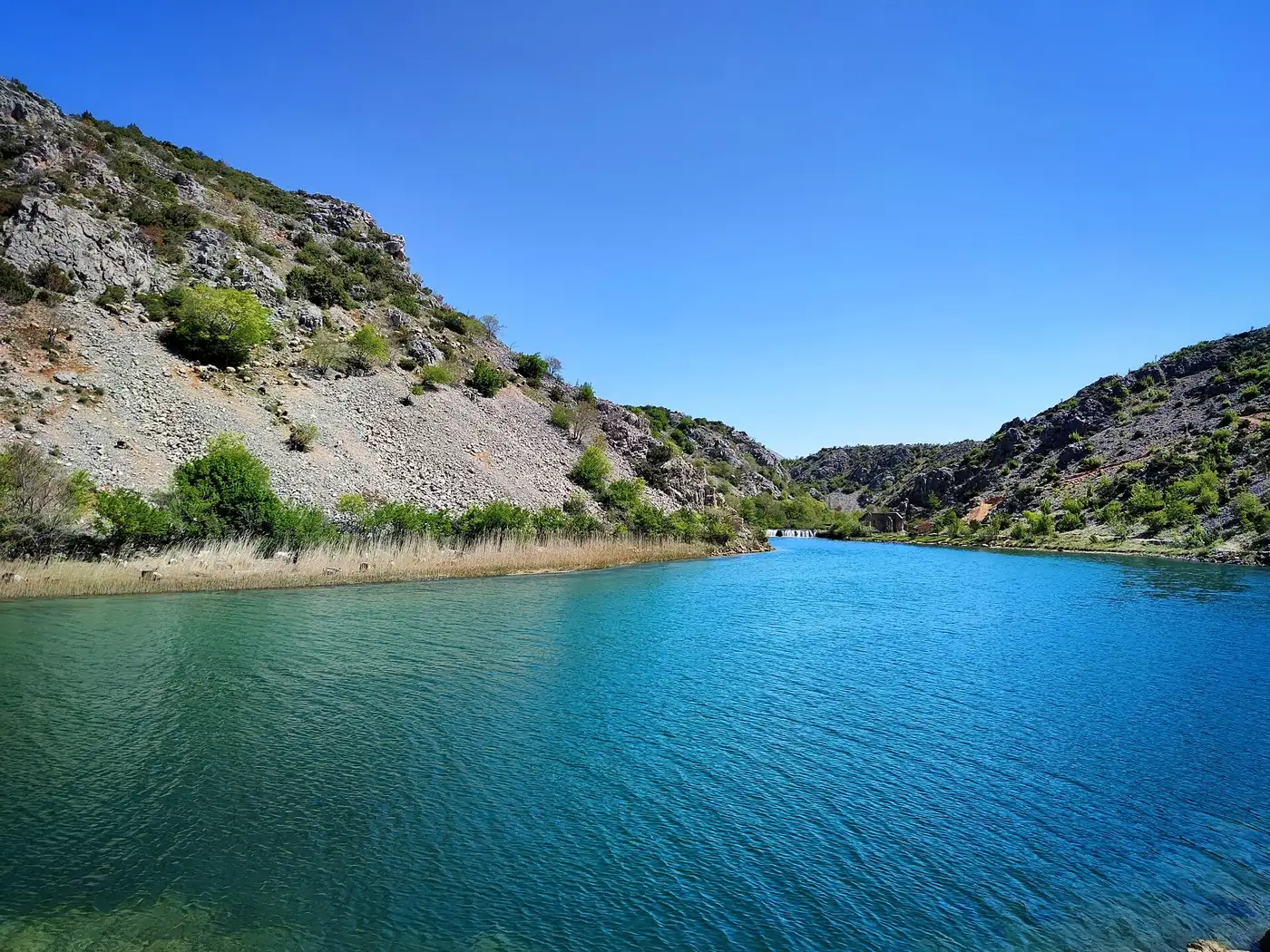
The Krupa is the Zrmanja's short, spring-fed tributary, and where it leaves its own gorge to join the big river it descends a stairway of nine tufa barriers — the terraces that English searches file under “Krupa waterfalls, Croatia” and the region calls Deveterac vrela, the nine springs. They sit inside the Velebit Nature Park on the left bank of the Zrmanja canyon, free to reach and deliberately hard to drive to: access is on foot down the trails or by water, with the guided kayak runs from Kaštel Žegarski passing the confluence. Half a kilometre downstream stands the Krupa monastery, founded in 1345 by monks from the Krka and the oldest Orthodox monastery in Dalmatia, with the arched Kudin bridge spanning the upper river nearby. This page covers the terraces, the monastery, the kayak arithmetic and the swimming.
Quick answer The nine springs, free access, the kayak route and the 1345 monastery in one read
Verified this quarter: the Krupa drops over nine tufa barriers in roughly a hundred metres of river just above its mouth into the Zrmanja — free to visit, inside the Velebit Nature Park, with no road to the terraces themselves. The practical ways in are the marked trails on foot or the guided half-day kayak run from Kaštel Žegarski that paddles the canyon past the confluence. The Krupa monastery downstream dates its foundation to 1345 and is the oldest Orthodox monastery in Dalmatia. Water levels follow the karst calendar: full barriers after spring rain, low threads by late August.
Key takeaways
- Nine tufa barriers, nine falls — Deveterac vrela, the nine springs — over about 100 m of river.
- Free access inside the Velebit Nature Park; no road reaches the terraces, plan to walk.
- The honest product is the half-day kayak tour on the Zrmanja, which passes the Krupa mouth.
- The 1345 Krupa monastery and the arched Kudin bridge double the visit's cultural weight.
- Seasonal karst flow: loud in spring, thin by late summer.
Key facts
Opening hours
| Open-air site — all year | Daylight–Daylight |
|---|
Closed None — the terraces are an unmanaged natural site inside the Velebit Nature Park; the monastery complex keeps its own visiting arrangements
Admission
- Adult
- Free — no ticket, gate or concession exists for the terraces (checked 2026-09-13)
- Reduced
- Not applicable; the kayak tours on the Zrmanja are priced separately on their booking pages
- Free
- Everything on foot: the falls, the tufa barriers and the riverside paths
Planning it
- Time needed
- 1-2 h for the terraces and the monastery path; half a day with the kayak run
- Address
- Krupa gorge at its mouth into the Zrmanja, near Kaštel Žegarski, Zadar County, Croatia
- GPS
- 44.17, 15.76
Krupa Waterfalls Tickets: Free Terraces and the Kayak Route
No ticket exists for the falls, verified this quarter; the only money decision is whether you reach them under your own power or book the kayak run that passes them. The table lays out both plus the warnings.
Choose the access method and the rest follows:
| Option | Access / window | Price | What it covers | Where it books | Book |
|---|---|---|---|---|---|
| Velebit Nature Park — managing public institutionAnyone planning the visit on foot | All year; the park site documents the Krupa's cultural landscape | Free | The terraces, the trails and the Krupa cultural landscape including Kudin bridge | Official institution site | Official site |
| Zrmanja half-day guided kayaking near ZadarVisitors who want the canyon and the confluence without route-finding | Fixed departures in the paddling season | From ~$64 on the card | Guide, equipment and the canyon run past the Krupa mouth — the honest way in by water | Tour card | Check Availability |
| Driving to the terracesDrivers hoping for a car park at the falls | No paved access exists | Lost time on the plateau tracks | Plan to walk in and carry water; the last stretches are trail, not road | Skip the drive-in idea | Check Availability |
| Treating the monastery as a tourist stopEveryone heading for the monastery | A living religious complex | Friction with the community | Dress modestly, keep voices low and check access arrangements before setting out | Skip the casualness | Check Availability |
What Deveterac Vrela Means
The local name says the shape out loud: nine springs, nine barriers, nine falls in a single kilometre of river.
Deveterac vrela — the nine springs, also written Bijeli buk — is the stretch where the Krupa breaks across nine travertine barriers, each throwing its own small waterfall, across roughly a hundred metres of channel just before the river meets the Zrmanja. The tufa grows the way it does across this karst: mosses and algae precipitate carbonate on the barriers, building white shelves that the water reorganises every flood season. Where the Krupa's own gorge narrows, the falls compress into one long white stairway; where it opens, they scatter into separate curtains between pools.
The setting explains the quiet. The whole stretch lies inside the Velebit Nature Park, whose managing institution documents the Krupa's cultural landscape — the falls, the old mills, the Kudin bridge — but builds nothing at the water. No road reaches the terraces, so the visitor numbers stay a fraction of the Plitvice boardwalks an hour east, and the people you meet arrive on foot or in kayaks. The Zrmanja below the mouth carries the big scenery: green water between limestone walls several hundred metres high in places.
The nine-barrier structure over roughly 100 m and the park setting follow the Velebit Nature Park institution and regional references, verified this quarter.
The 1345 Monastery and the Kudin Bridge
Two cultural anchors justify the walk even when the water runs low.
The Krupa monastery stands on the left bank of the Zrmanja at the Krupa's mouth, in a gorge the founding monks chose for its isolation. Tradition dates the foundation to 1345, when monks came from the Krka monastery further south — which makes Krupa the oldest Orthodox monastery in Dalmatia and the second oldest in Croatia. The single-nave church is dedicated to the Assumption of Mary; the community kept an icon of the Virgin, credited with healing powers, from its earliest years. Ottoman pressure emptied the complex at times — it may have been abandoned by the mid-sixteenth century — but restorations after 1699 rebuilt the residence, and the stone bell tower of 1782 still stands over the gorge. The monastic community is small today; treat the place as a living site, not a museum.
On the Krupa itself, upstream of the falls, the Kudin bridge (Kudin most) carries an old track across the river on a line of low stone arches — the signature monument of the Krupa's cultural landscape and a good turnaround point for a walk that combines the bridge, the nine falls and the monastery in one loop.
- Monastery founded 1345 by monks from the Krka — oldest Orthodox monastery in Dalmatia.
- Bell tower completed 1782; church dedicated to the Assumption of Mary.
- Kudin most: the arched stone bridge on the upper Krupa, part of the documented cultural landscape.
- A modest, living monastic site — modest dress and quiet voices apply.
Foundation date, hierarchy among Croatian monasteries, the 1782 tower and the icon follow the monastery's published histories, verified this quarter; the Kudin bridge appears on the Velebit Nature Park institution's documentation.
Three Ways to Reach the Terraces
Access is the whole planning problem at this site; the table compares the three realistic approaches using the trail and river conditions verified this quarter.
| Approach | Time and effort | Cost | What you see | Best for |
|---|---|---|---|---|
| On foot from the plateau trails | 1.5-2 h round trip on marked paths | Free | The nine barriers from above, the monastery gorge, the canyon rim | Walkers with half a day and good shoes |
| Guided kayak run on the Zrmanja | Half a day, guided | From ~$64 on the tour card | The canyon walls, the Krupa mouth and its white stairway from the water | First-timers; anyone without route knowledge |
| Private paddling trip | Self-timed | Rental fees apply | The same water at your own pace, portages included | Experienced paddlers only |
Swimming and the Karst Calendar
The Krupa is a spring river: its volume tracks rainfall with little delay, and the pools below the barriers warm quickly.
Swimming is lawful along this stretch — the Velebit Nature Park imposes no bathing ban on the Krupa or the Zrmanja canyon — and the pools between the tufa shelves are the natural bathing spots: clear, green, and shallow enough to warm in summer. Enter below the barriers where the current slackens, and treat the tufa as the fragile living structure it is: step on rock and gravel, not on the moss curtains that build the falls.
The calendar matters more here than at any big-name fall. After autumn and spring rain the nine barriers run as one continuous white stairway; by late July and August the karst sources shrink and the falls thin to trickles between pools — beautiful, but not the full staircase. The kayak season rides the same calendar: spring and early summer bring the best combination of volume and warm water. For a month-by-month read across the country, the best time to visit page grades the seasons.
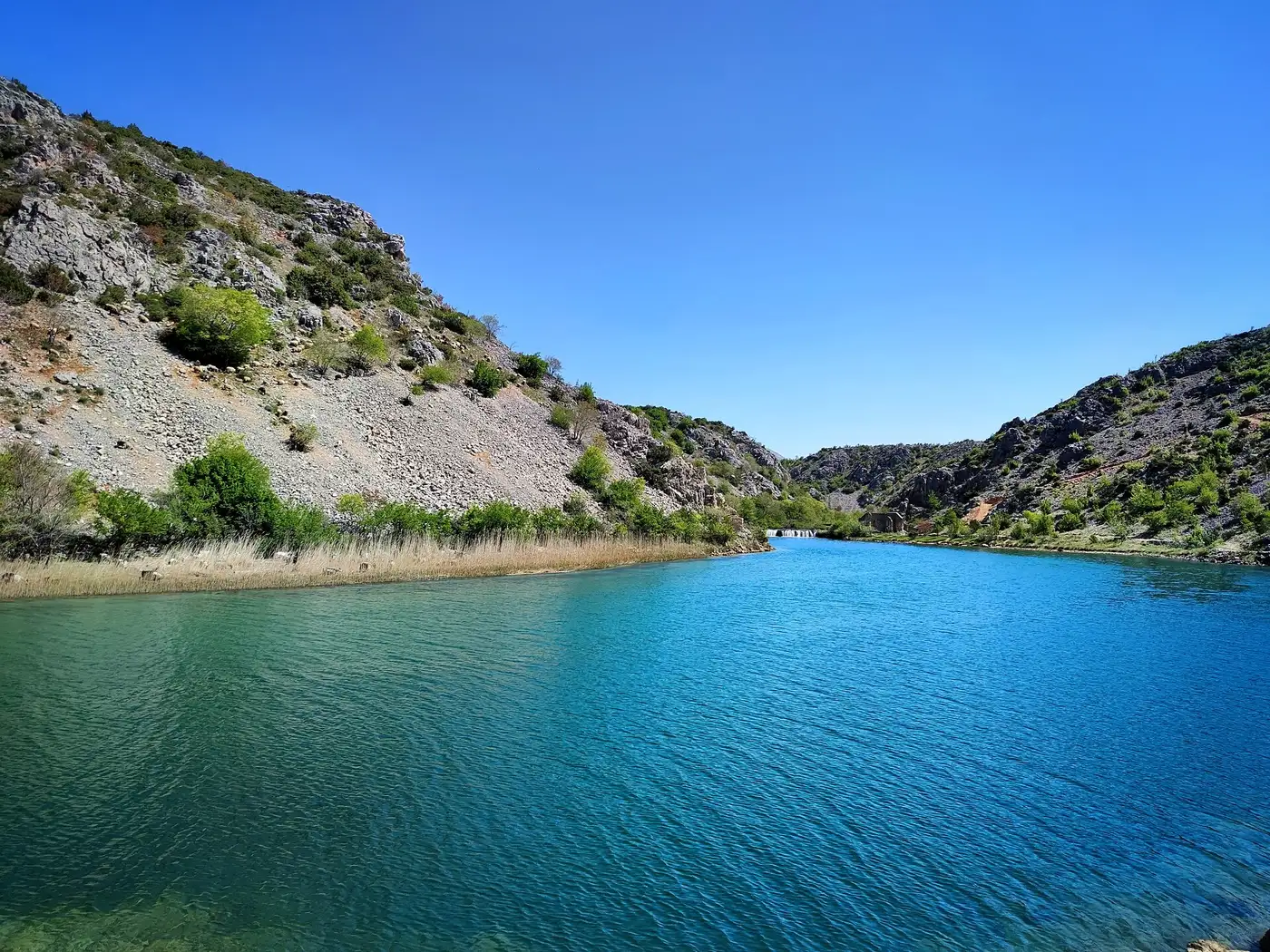
The Zrmanja canyon at the Krupa's mouth — the terraces of Deveterac vrela feed into this green water, and the guided kayak runs pass the confluence in season.
Krupa Waterfalls Map: the Terraces, the Monastery and the Put-In
The falls and the cultural anchors, with the kayak put-in at Kaštel Žegarski for the water approach.
The Kayak Run That Passes the Falls
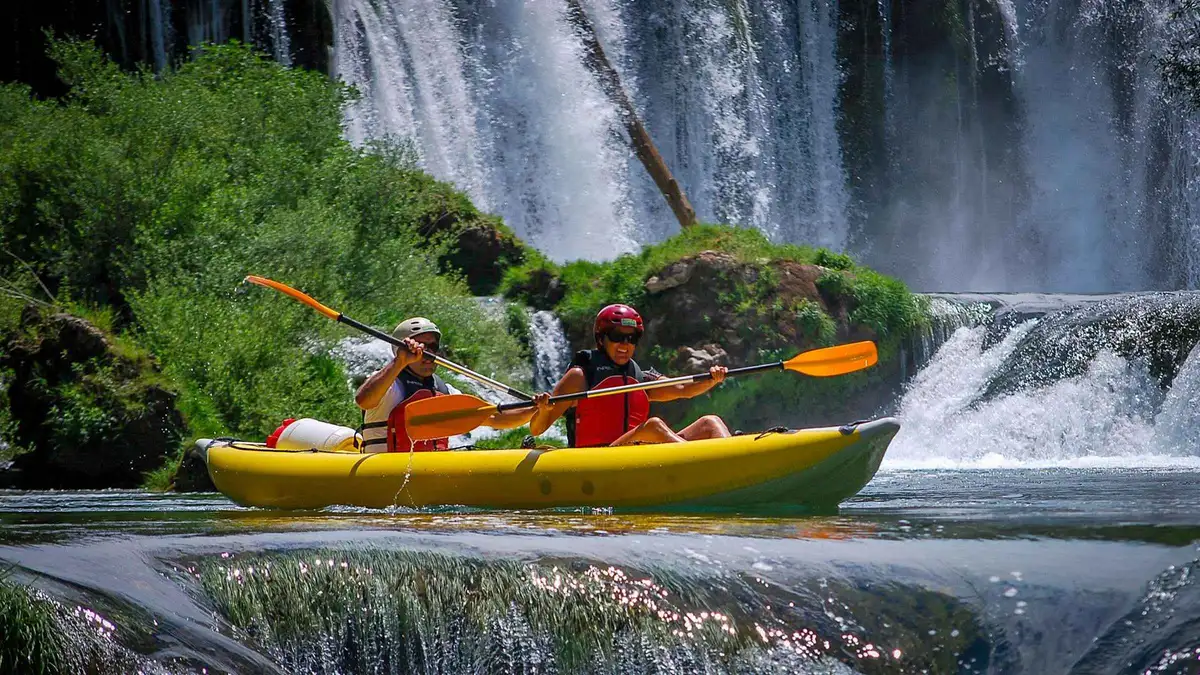
One bookable product serves this river honestly: the half-day guided kayak tour from Kaštel Žegarski runs the Zrmanja canyon past the Krupa confluence. Nothing on the booking platforms stops at the terraces themselves — treat the tour as the water approach, not a falls excursion.
 from $63.79
Zrmanja River: Half-Day Guided Kayaking Tour Near Zadar
Half-day guided kayak run down the Zrmanja canyon's easy rapids from Kastel Zegarski.
Check AvailabilityPrices, ratings and details are the platform's own, checked in Q3 2026; dollar figures are the listed prices — the platform bills in your account's currency.
Krupa Waterfalls: Questions, Answered
Where does the name Deveterac vrela come from?
From the shape of the river: devet is nine, and the Krupa breaks over nine tufa barriers with nine separate falls in roughly a hundred metres of channel. Some sources also call the stretch Bijeli buk — the white fall.
Can you drive to the falls?
No road reaches the terraces. You walk in on marked trails from the plateau above, or you see them from the water on the kayak run that paddles past the mouth. The tracks on the plateau are for locals and farm traffic.
Is the monastery open to visitors?
The complex is a living monastic site rather than a ticketed museum — visits are possible but modest dress and quiet conduct apply, and arrangements can change. Check locally before building the visit around it.
Does the kayak tour pass the falls?
Yes — the guided half-day run from Kaštel Žegarski paddles the Zrmanja canyon and passes the Krupa confluence, where the white stairway of the tributary is visible from the water. It does not paddle up the Krupa gorge itself.
Can you swim here?
Yes — no bathing ban applies on this stretch. The pools between the barriers are the natural spots; enter where the current slackens and keep off the living tufa curtains that build the falls.
Is this inside a national park?
Not a national park — the falls sit inside the Velebit Nature Park, a protected area managed by a public institution, which is why access stays free and undeveloped. The Zrmanja canyon shares the protection.
How far is it from Zadar?
Roughly an hour by road to Kaštel Žegarski and the canyon trailheads. The kayak tours bill themselves as 'near Zadar' for the same reason — the drive is the trip's only logistical burden.
Where to Go From the Krupa
The pages this one leans on — the canyon around it, the paddle product and the swim directory:
Zrmanja kayaking
The half-day guided run from Kaštel Žegarski — the honest way onto this water.
Zrmanja waterfalls
The canyon system both rivers share, from the springs to the lower reaches.
Waterfalls near Zadar
The Zadar day-trip radius, with the Krupa and the canyon at its centre.
Croatia waterfalls you can swim in
The lawful-swim directory — the Krupa's pools belong on any such list.
Free waterfalls in Croatia
Gate-free falls countrywide; this site costs nothing but the walk.
We may earn a commission if you book through one of our links, at no extra cost to you. Full affiliate disclosure